How to Recognize Signs of Panic Attack Before They Get Worse

Let’s talk about something real and often misunderstood — signs of panic attack​.

Because here’s the truth… it doesn’t always start like a big dramatic moment. It usually starts small. Almost silent.

One moment everything feels fine… and then suddenly the body starts reacting.

Heart starts beating faster. Breathing feels a bit off. Chest feels tight. And before even understanding what’s happening, fear shows up and takes control.

That is exactly why recognizing the signs of panic attack​ early is so important. Because once you catch it early, you can slow it down before it takes over completely.

And most people don’t recognize it at first. They think it’s stress. Or tiredness. Or just “overthinking.”

But a panic attack doesn’t wait for permission. It just shows up.

Social anxiety disorder

What a Panic Attack Actually Feels Like

Let’s keep this simple.

A panic attack feels like the body is shouting “danger” when there is no danger at all.

So everything speeds up.

  • Heart starts racing like something is wrong
  • Breathing feels short or stuck
  • Chest feels tight or heavy
  • Hands start shaking
  • Head feels light or weird
  • Fear suddenly becomes very strong

These panic attack symptoms feel so real that many people genuinely think they are having a heart attack.

That’s how intense it can feel.

Early Signs of Panic Attack (This Is Where It Starts)

Now this part is important. Because this is where you can actually catch it early.

Heart suddenly starts going fast

One of the first signs of panic attack​ is a rapid heartbeat.

No running. No activity. But still… the heart starts pounding hard.

And the mind immediately jumps in:

“What is happening to me?”

Sometimes people even think it’s a rapid heartbeat disease or something serious.

That thought alone makes it worse.

Breathing starts feeling off

Then comes shortness of breath.

It doesn’t mean you are not breathing. It feels like:

“I can’t get a full breath in.”

And the more you try to force it, the more uncomfortable it feels.

Chest tightness shows up

Another very common signs of panic attack​ is chest tightness.

It can feel like pressure sitting on the chest.

Sometimes even left chest tightness and pain shows up, which makes people panic even more because it feels serious.

Fear suddenly takes over

This is where it really changes.

A strong fear of losing control shows up.

And the thoughts start going:

  • Something is wrong
  • I am not safe
  • I can’t handle this

Even though nothing dangerous is actually happening.

Anxiety Attack vs Panic Attack (Simple way to understand)

People often confuse panic attack vs anxiety attack, so let’s break it down in a real way.

Anxiety feels like:

  • Worry building slowly
  • Thinking too much
  • Stress sitting in the background

Panic feels like:

  • Sudden wave of fear
  • Body going into alarm mode
  • Everything happening at once

So when you compare Anxiety Attack vs Panic Attack, panic is fast, sharp, and physical.

Anxiety is slower and more mental.

What Causes Panic Attacks?

Now the big question people always ask: what causes panic attacks?

Honestly, it’s not just one thing.

It can come from:

  • Long-term stress
  • Emotional pressure
  • Trauma from past experiences
  • Too much caffeine
  • Lack of sleep
  • Overthinking patterns
  • Anxiety conditions

Sometimes even Social anxiety disorder can trigger it in crowded or social situations.

And sometimes… it comes without any clear reason at all.

That’s what makes it confusing.

Panic Attacks at Night (Nocturnal Panic Attacks)

Yes, it can even happen while sleeping.

These are called nocturnal panic attacks.

Imagine this…

You are asleep… and suddenly you wake up feeling:

  • Heart pounding
  • Fear instantly present
  • Breathing feels off
  • Chest tightness

And the worst part?

There is no dream. No warning. Nothing.

Just sudden fear in the middle of the night.

Physical Signs of Panic Attack You Should Notice

Let’s clearly list the body signs, because these are the most noticeable signs of panic attack:

  • Rapid heartbeat
  • Shortness of breath
  • Chest tightness
  • Sweating
  • Shaking
  • Dizziness
  • Weak legs or body
  • Tingling in hands or face
  • Nausea feeling

This is the body basically hitting a false alarm button.

Emotional Signs of Panic Attack

Now the emotional side.

This is what people often don’t talk about.

  • Fear of dying
  • Fear of losing control
  • Feeling disconnected
  • Feeling trapped inside your own body
  • Feeling like something bad is coming

And even after it settles… the mind stays shaken for a while.

How Long Do Panic Attacks Last?

A common question: how long do panic attacks last

Here’s the simple answer.

  • Peaks in about 5 to 10 minutes
  • Starts calming in 20 to 30 minutes

But the emotional after-feeling… that can stay longer.

Like tiredness. Fear. Or feeling “off” for a while.

Panic Attack Treatment (What actually helps)

Now let’s talk about control and recovery.

Talking to a therapist helps

A therapist for panic attacks helps understand what is triggering these episodes and how to respond differently.

Medication (in some cases)

Sometimes doctors suggest panic attack medication, especially if attacks are frequent or severe.

Daily habits make a big difference

Simple things really help:

  • Better sleep
  • Less caffeine
  • Light exercise
  • Deep breathing
  • Reducing stress load

Small changes calm the nervous system over time.

therapist for panic attacks​

How to Help Someone Having a Panic Attack

If someone is going through it, this is what actually helps.

Do this:

  • Stay calm yourself first
  • Speak slowly and gently
  • Say things like “you are safe”
  • Stay with them
  • Help them breathe slowly

Don’t do this:

  • Don’t shout “relax”
  • Don’t panic in front of them
  • Don’t dismiss it like it’s nothing

Calm energy is everything in that moment.

Sleep and Panic Attacks

Many people also face sleep disturbances.

It can look like:

  • Trouble falling asleep
  • Waking up suddenly
  • Fear before sleeping
  • Restless nights

And poor sleep can actually make panic worse the next day.

When to Take It Seriously

The signs of panic attack should be taken seriously when:

  • It keeps happening again and again
  • It affects sleep
  • It starts affecting daily life
  • It creates fear of normal situations
  • It becomes hard to function normally

At that point, support is important.

Not later. Not “someday.” Now.

Conclusion:

Here’s the simple truth.

The signs of panic attack feel scary… but they are not dangerous in the way they feel.

It’s the body reacting too strongly, not the body breaking.

Once you recognize early signs like rapid heartbeat, shortness of breath, and chest tightness, you start gaining control back.

And that changes everything.

Because panic doesn’t get stronger when you understand it.

It gets weaker.

Frequently Asked Questions

What are the first signs of panic attack?

The first signs of panic attack usually include fast heartbeat, chest tightness, short breathing, dizziness, and sudden fear that appears without warning.

Can panic attacks start suddenly?

Yes, they often start suddenly even when everything feels normal.

What is the difference between anxiety and panic attack?

Anxiety builds slowly over time, while panic attacks hit suddenly and feel physically intense.

Can panic attacks feel like heart problems?

Yes, because symptoms like chest tightness and rapid heartbeat feel very similar, but they are not the same.

How long do panic attacks last?

Most panic attacks peak within 10 minutes and calm down within 20 to 30 minutes.

What causes panic attacks?

Stress, trauma, overthinking, lack of sleep, caffeine, and anxiety disorders are common causes.

Can panic attacks happen during sleep?

Yes, nocturnal panic attacks can wake someone suddenly with fear and physical symptoms.

What helps during a panic attack?

Slow breathing, staying calm, grounding techniques, and reassurance help reduce symptoms.

Do panic attacks need treatment?

If they happen often, yes — therapy or lifestyle changes can help a lot.

How to help someone having a panic attack?

Stay calm, speak softly, reassure them they are safe, and stay with them until it passes.

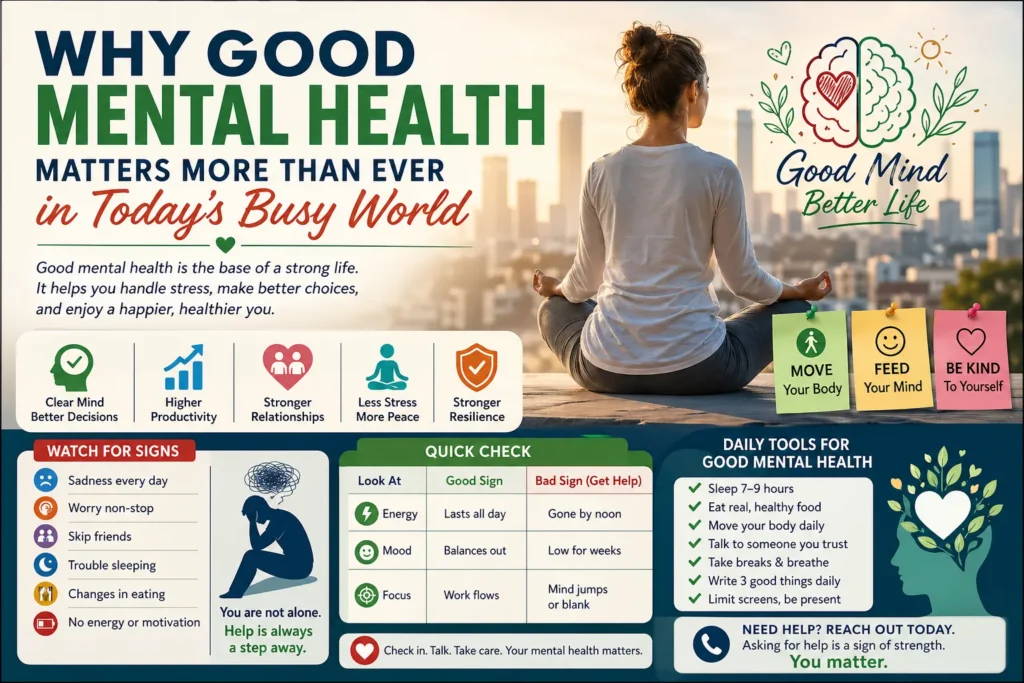
Why Good Mental Health Matters More Than Ever in Today’s Busy World

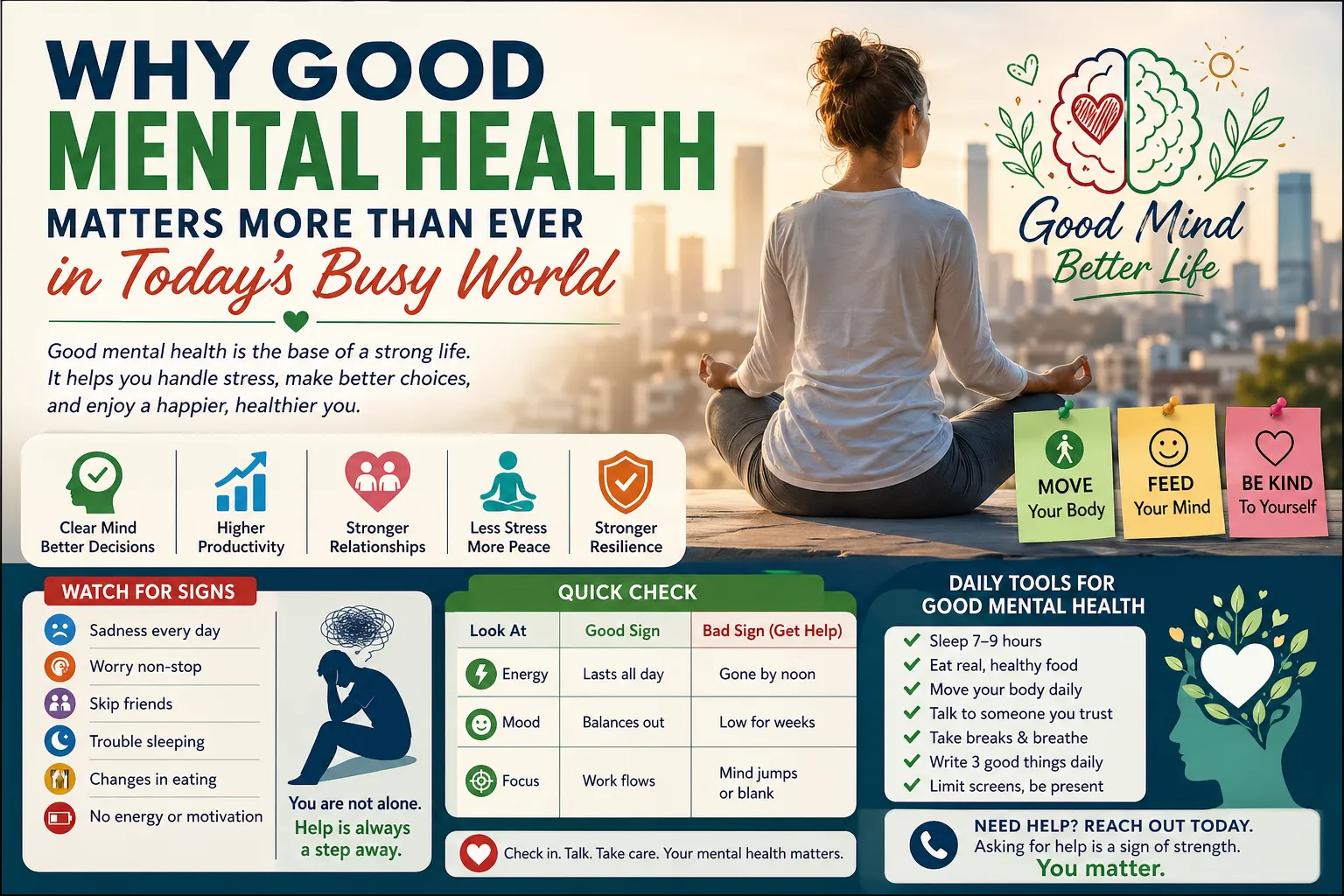
Good mental health is the base of a strong life in this busy world. People run after work, family, and screens all day. Without good mental health, everything falls apart fast. It lasts when you build strong walls against daily grind. 

Why Good Mental Health Comes First

Good mental health keeps you steady when life gets crazy. Deadlines stack up and stress builds, but good mental health helps you push through. It makes work and home life easier to handle.

Forget good mental health, and small problems grow big. One rough day turns into weeks of worry. Good mental health means a clear head and smart choices.

Why Is Mental Health Important Today?

Phones buzz nonstop, news scares you, and alone time grows even with people around. Good mental health fights back and builds strength.

The importance of mental health links to better work. People with good mental health think fast and stay happy. Skip it, and you lose days off sick or tired.

Spot Signs Mental Disorders Early

Signs of mental disorders start quiet. You feel tired all the time, even with sleep. Or you get mad at small things. Good mental health feels even; these signs mean trouble.

Signs you need mental help show as hiding from friends. Fun things lose joy. My mood stays low for weeks. Watch sleep and eating—they change first in mental health issues.

Signs Mental DisordersWhat You See
Sadness every dayCry or feel empty
Worry non-stopThoughts race at night
Skip friendsEvents feel too much

Common Mental Health Conditions

Mental health conditions come in many forms. Depression symptoms mean no energy, sadness all time, no fun left. Anxiety attack symptoms bring fast heart, dizzy head, fear rush.

Bipolar disorder flips high to low. High means no sleep, wild ideas. Low means deep sadness. Narcissistic personality disorder needs all praise, no care for others. Manic depression symptoms match bipolar ups and downs.

Good mental health spots these early. Act quick

Good Mental Health Matters

Watch for Mental Health Issues

Mental health issues hit differently for each. Good mental health grows with walks, talks, and rest. No good mental health, and anxiety attack symptoms or depression symptoms take over.

Why is mental health important? Bad mental health hurts your job, family, and body. Good mental health and wellness mixes calm habits and help when needed.

  • Sleep 7-9 hours for good mental health.
  • Eat real food, not junk.
  • Move your body to lift your mood.

Know Signs You Need Mental Help

Signs you need mental help come fast. Dark thoughts? Panic hits out of blue? The body says help now. Good mental health has ups and downs but tools to fix.

Friends see it first, you pull away, get cranky. Good mental health bounces back; these signs need doctor talk. Life throws curveballs like job loss or fights, but good mental health stays firm with practice.

Check in weekly, ask how mood holds up, what drains energy most. Small tweaks like cutting toxic chats keep good mental health alive for years. 

Quick Check Table:

Look AtGood SignBad Sign (Get Help)
EnergyLasts all dayGone by noon
MoodBalances outLow for weeks
FocusWork flowsMind jumps or blank

Treatment for Depression Basics

Treatment for depression starts easy. Talk to the helper unpacks why. Pills fix brain balance if needed. Good mental health builds back step by step.

Add sun walks, write feelings. Why is mental health important? Good treatment for depression brings back smiles and drive.

Steps:

  • See doctor for check.
  • Try talk therapy.
  • Find support friends.

Grow Mental Health and Wellness

Mental health and wellness comes from daily habits. Good mental health likes morning breath, night calm. List good things to stop bad thoughts.

Busy life skips this, but good mental health needs time. Signs of mental disorders go when wellness wins.

Talk on Bipolar and Others

Bipolar disorder wrecks steady life. Manic depression symptoms mean wild high then crash low. Good mental health knows stress starts it.

Narcissistic personality disorder breaks bonds; no care shown. Good mental health sets limits, shows care.

Your Good Mental Health Tools

Good mental health tools fit busy days. Deep breaths in traffic. Real talks, not phone scrolls. Why is mental health important? Tools stop mental health conditions.

  • Write 3 good things at night.
  • No screens before bed.
  • Walk outside weekly.

Boost Good Mental Health at Work

Good mental health powers through office chaos and long hours. Deadlines loom, meetings drag, but good mental health sharpens focus and cuts stress. Take short breaks to stretch or chat with a coworker—mental health grows when work stays in check.

Busy jobs test limits, yet good mental health wins with boundaries like no emails after hours. Set desk reminders for water and walks; good mental health turns tough days into steady wins.

Conclusion:

Skip this, and mental health issues sneak back stronger. Good mental health thrives on patience; rush fixes fade fast. Track wins in a notebook, share burdens early—good mental health turns into your best friend through every season. 

Frequently Asked Questions

Why is mental health important every day?

Good mental health helps make good choices, keeps friends close, and brings real happiness. No it, stress wins, work stops, body hurts—start now for a strong life. 

What are signs mental disorders begin?

Sad all time, sleep mess, hide from people—good mental health stays steady. This means talking to a helper before the worst. 

How do depression symptoms start?

No energy, eat changes, feel no hope—depression symptoms kill drive. Catch early, good mental health comes back. 

What starts with anxiety attack symptoms?

Heart fast, breath short, big fear—anxiety attack symptoms come quickly. Use breaths for good mental health. 

Bipolar disorder same as manic depression symptoms?

Bipolar goes high and low, like manic depression symptoms. Good mental health uses pills, talks for steady.

What is narcissistic personality disorder?

Always want praise, no care for others—narcissistic personality disorder. Keep good mental health with strong limits. 

When signs you need mental help fast?

Bad thoughts, alone all time, can’t be done daily. These are the signs you need mental help now. Good mental health starts with a call. 

Best treatment for depression?

Talks fix thoughts, pills help the brain, treatment for depression with habits builds good mental health.

How does good mental health help at work?

Better think, not tired but good mental health makes more work done, happy team. No, problems slow everything.

Do mental health and wellness habits stop problems?

Walks, talks, rest make mental health and wellness strong. Good mental health shows signs of mental disorders soon.

Health Counselling: Practical Solutions for Better Mental and Emotional Well-Being

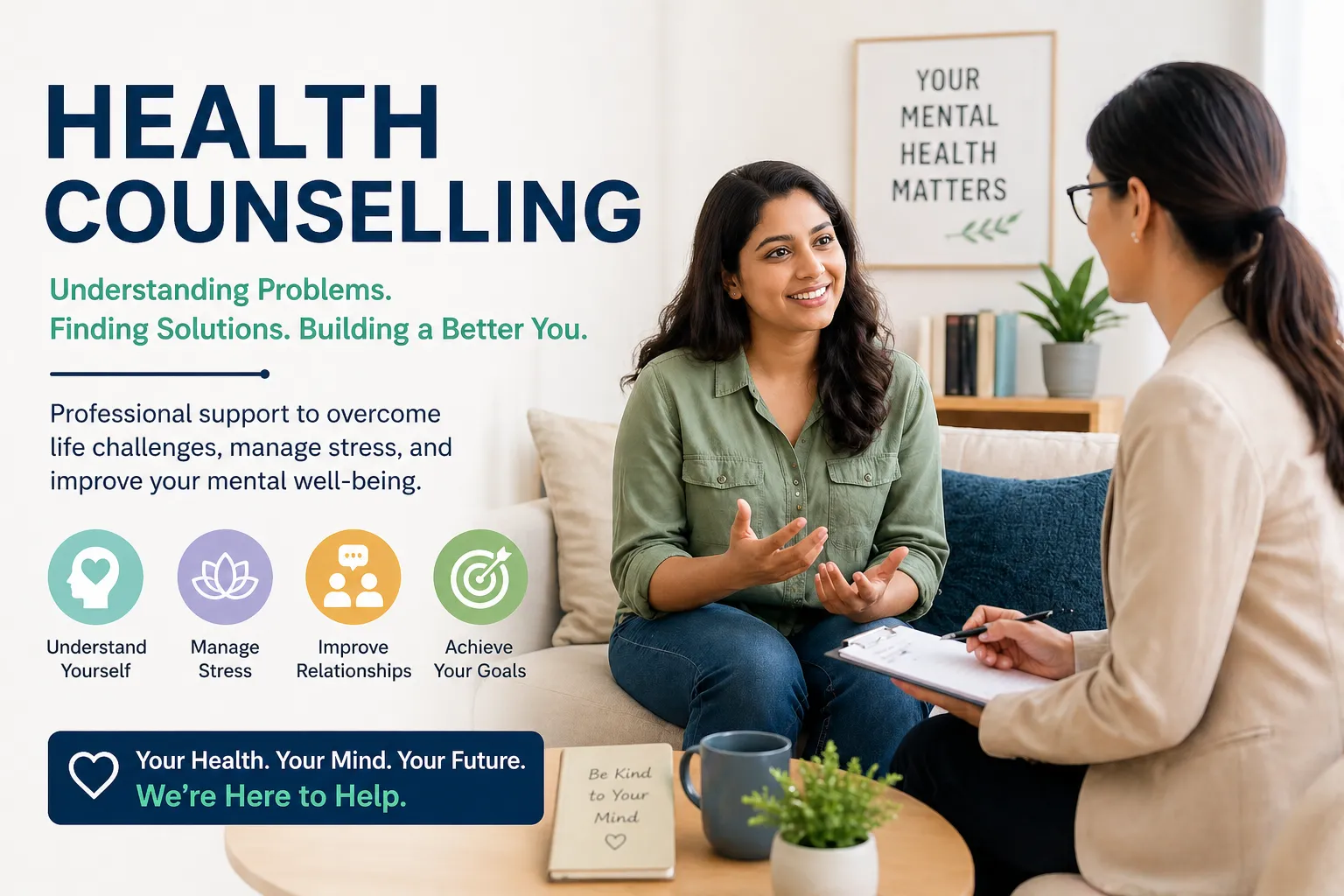
Health counselling plays a crucial role in helping individuals manage emotional, psychological, and lifestyle challenges. In today’s fast-paced world, many people struggle with stress, anxiety, relationship issues, and health-related concerns. These problems can affect daily life, productivity, and overall happiness. Health counselling offers structured, evidence-based solutions to help individuals understand their problems and take meaningful steps toward improvement.

This guide focuses on solving real-life problems through health counselling, explaining how it works, when to seek help, and how it can bring long-term positive change.

Understanding Health Counselling and Its Purpose

Health counselling is a professional service that supports individuals in improving their mental, emotional, and behavioral health. It combines psychological techniques, communication strategies, and lifestyle guidance to address a wide range of issues.

Unlike general advice from friends or family, health counselling is based on scientific methods and tailored approaches. Counsellors assess each individual’s situation and provide practical solutions that are realistic and achievable.

Common Problems Health Counselling Can Solve

Many people delay seeking help because they are unsure whether their issues are serious enough. In reality, health counselling addresses a variety of everyday challenges, including:

  • Stress and burnout from work or studies
  • Anxiety and constant worrying
  • Depression or low mood
  • Relationship conflicts
  • Low self-esteem or lack of confidence
  • Difficulty coping with life changes

These problems may seem small at first but can grow if ignored. Health counselling services helps identify the root cause and provides strategies to manage them effectively.

Signs You May Need Health Counselling

Recognizing the need for help is often the first step toward solving a problem. You should consider health counselling if you experience:

  • Persistent stress or emotional exhaustion
  • Trouble sleeping or changes in appetite
  • Feeling overwhelmed by daily responsibilities
  • Difficulty managing anger or emotions
  • Loss of interest in activities you once enjoyed

Seeking help early can prevent these issues from becoming more severe and harder to manage.

Health Counselling Benefits, Process and Solutions

How Health Counselling Provides Solutions

One of the most valuable aspects of health counselling is its problem-solving approach. Instead of just discussing issues, counsellors focus on actionable steps to improve well-being.

Identifying the Root Cause

Counsellors help you explore underlying factors contributing to your problems. This may include past experiences, current stressors, or unhealthy thought patterns.

Developing Coping Strategies

Health counselling teaches practical techniques such as stress management, emotional regulation, and mindfulness. These skills empower individuals to handle challenges independently.

Improving Communication Skills

Many problems arise from poor communication. Counsellors guide individuals on how to express themselves clearly and build healthier relationships.

Setting Realistic Goals

A structured plan with achievable goals helps individuals track progress and stay motivated. This approach ensures long-term improvement rather than temporary relief.

Types of Health Counselling Approaches

Different problems require different solutions. Health counselling includes various methods tailored to individual needs:

  • Cognitive Behavioral Therapy (CBT) for managing negative thoughts
  • Solution-focused counselling for goal-oriented progress
  • Family counselling to resolve relationship conflicts
  • Lifestyle counselling for improving habits and routines

Each approach is designed to address specific challenges while promoting overall well-being.

Benefits of Health Counselling

Health counselling offers both short-term relief and long-term benefits. Some key advantages include:

  • Better stress management and emotional control
  • Improved relationships and communication
  • Increased self-awareness and confidence
  • Enhanced decision-making skills
  • Greater overall life satisfaction

These benefits contribute to a healthier and more balanced lifestyle.

Practical Tips to Support Counselling Outcomes

While counselling provides professional guidance, personal effort is equally important. Here are some steps to enhance results:

  • Maintain a consistent routine
  • Practice mindfulness or relaxation techniques
  • Stay physically active
  • Build a support network of trusted individuals
  • Be open and honest during counselling sessions

Combining these habits with professional counselling can significantly improve outcomes.

When Should You Start Health Counselling?

Many people wait until problems become overwhelming before seeking help. However, health counselling is most effective when started early. If your challenges are affecting your daily life, relationships, or mental health, it is time to take action.

You can explore helpful guidance through Mental wellness support programs or learn more about professional help via Health counselling services to take the first step toward improvement.

Overcoming Stigma Around Counselling

One of the biggest barriers to seeking help is social stigma. Some individuals feel that asking for help is a sign of weakness. In reality, it is a proactive step toward self-improvement and personal growth.

Health counselling is not just for severe conditions; it is a valuable tool for anyone looking to improve their quality of life.

FAQs About Health Counselling

What is the main goal of health counselling?

The primary goal is to help individuals understand their problems and develop practical solutions to improve mental and emotional well-being.

How long does counselling take to show results?

Results vary depending on the individual and the issue, but many people notice improvements within a few sessions.

Is health counselling only for mental illness?

No, it is beneficial for anyone facing stress, life challenges, or personal development goals.

Can counselling be done online?

Yes, many professionals offer online sessions, making it more accessible and convenient.

Is everything discussed in counselling confidential?

Yes, confidentiality is a key principle, ensuring a safe and private environment for clients.

Final Thoughts

Health counselling is a powerful solution for managing life’s challenges and improving overall well-being. By addressing problems early, developing coping strategies, and seeking professional guidance, individuals can lead healthier, more fulfilling lives. Taking the first step toward counselling can be the beginning of lasting positive change.

Child Psychiatry: Practical Solutions for Children’s Mental Health Challenges

Child psychiatry is a specialized branch of medicine focused on diagnosing, treating, and preventing mental, emotional, and behavioral disorders in children and adolescents. As modern life becomes more complex, many children face stressors that can affect their mental well-being. Parents and caregivers often feel overwhelmed when they notice changes in behavior, mood, or development. This guide aims to solve common concerns by explaining how child psychiatry works, when to seek help, and what solutions are available.

Why Child Psychiatry Matters More Than Ever

Children are not just “small adults.” Their brains are still developing, and their emotional responses can differ significantly from adults. Early intervention through child psychiatry can prevent long-term issues such as academic struggles, social isolation, or chronic mental health conditions.

Common challenges addressed by child psychiatrists include anxiety disorders, attention-deficit/hyperactivity disorder (ADHD), depression, autism spectrum disorders, and behavioral issues. Recognizing these conditions early allows for effective treatment plans that improve a child’s quality of life.

Common Signs That Indicate a Problem

Parents often struggle to differentiate between normal behavior and signs of a deeper issue. Here are some problem indicators that may require professional attention:

  • Persistent sadness or irritability
  • Difficulty concentrating or sudden decline in school performance
  • Extreme fears or worries
  • Changes in sleep or eating habits
  • Withdrawal from friends or family
  • Frequent temper outbursts or aggression

If these signs last for weeks or worsen over time, consulting a child psychiatrist can help identify the root cause and provide solutions.

What Causes Mental Health Issues in Children?

Understanding the cause is key to solving the problem. Child mental health issues often arise from a combination of factors:

  • Biological factors such as genetics or brain chemistry
  • Environmental influences like family conflict or trauma
  • Social pressures including bullying or academic stress
  • Developmental challenges that affect emotional regulation

A psychiatrist evaluates all these aspects to create a personalized treatment plan.

How Child Psychiatry Solves These Problems

One of the biggest concerns for parents is how these issues can be effectively treated. Child psychiatry offers a range of solutions tailored to each child’s needs.

Therapy-Based Solutions

Psychotherapy is often the first step. Cognitive Behavioral Therapy (CBT), play therapy, and family therapy help children express emotions and develop coping strategies. These approaches are especially effective for anxiety, depression, and trauma-related conditions.

Medication When Necessary

In some cases, medication may be prescribed to manage symptoms such as severe ADHD or mood disorders. Child psychiatrists carefully monitor dosage and progress to ensure safety and effectiveness.

Family Involvement

Parents play a crucial role in treatment. Child psychiatrists often guide families on communication strategies, discipline techniques, and ways to create a supportive home environment.

School Collaboration

Many mental health challenges impact academic performance. Psychiatrists may work with teachers or school counselors to implement supportive strategies in the classroom.

Practical Tips for Parents

While professional help is essential, there are steps parents can take immediately to support their child:

  • Listen actively without judgment
  • Maintain a consistent daily routine
  • Encourage open communication
  • Limit screen time and promote physical activity
  • Build a safe and supportive home environment

These small changes can make a significant difference when combined with professional care.

When Should You Seek Help?

A common problem parents face is deciding when to seek professional help. If your child’s behavior interferes with daily life, relationships, or school performance, it is time to consult a specialist. Early intervention often leads to faster and more effective recovery.

You can also explore more guidance through Child mental health resources or learn about expert care via Child psychiatry services to better understand available support options.

Benefits of Early Intervention

Addressing mental health issues early can prevent long-term complications. Children who receive timely support are more likely to:

  • Develop healthy coping mechanisms
  • Improve academic performance
  • Build stronger relationships
  • Gain emotional resilience

Ignoring symptoms, on the other hand, may lead to more complex challenges in adulthood.

FAQs About Child Psychiatry

What age should a child see a psychiatrist?

Children as young as preschool age can benefit from psychiatric evaluation if they show concerning behavioral or emotional signs.

Is medication always required?

No, many conditions can be managed with therapy alone. Medication is only used when necessary and under careful supervision.

How long does treatment take?

The duration varies depending on the condition. Some children improve within months, while others may need long-term support.

Can parents be involved in therapy?

Yes, parental involvement is often encouraged as it improves treatment outcomes.

Is child psychiatry different from psychology?

Yes, psychiatrists are medical doctors who can prescribe medication, while psychologists focus mainly on therapy and behavioral interventions.

Final Thoughts

Child psychiatry provides practical, evidence-based solutions to some of the most challenging issues children face today. By recognizing early signs, understanding the causes, and seeking professional help, parents can ensure their children grow into emotionally healthy and resilient individuals. Taking action today can make a lifelong difference in your child’s mental well-being.

Understanding of Psychotherapy

Tick, Tick, Tick

The history of medicine is millennia long.  It has been characterized by genuine curiosity, it has sometimes been misguided or wrong, it has included gradual, and wonderful, development and understanding, and even those considered qualified to manage it have been increasingly highly regulated.  That is not to say that there has not been a snake oil industry, charlatans, and a focus on money — there most certainly has — but the general trend is toward improvement, better understanding, and better results.  Unfortunately, that has been much more true in other countries than it has in this one.

The history of psychiatry has been much harder to track and characterize, in part because of very long stretches of time when the concept of (separately understood and diagnosable) psychiatric conditions was either not understood or not accepted.  And because a significant proportion of what we would call psychiatric problems has been subjective, or subject to varying interpretation, then the confident recognition and understanding of psychiatric problems has been slower, and sometimes less confident, to rely on.

It is loosely fair to say that the history of psychiatry, at least in this country, is about 200-250 years old.  Benjamin Rush is a marker.  And concepts of psychiatric diagnoses and treatments have been very unsteady, and unreliable anyway.

Even today, in what we might like to tell ourselves are enlightened and advanced times, concepts of psychiatric diagnosis, and especially treatment, are not clear, and not agreed.  There are several reasons for this stalling and misdirection, not least of which are things like the common human wish for something new (whether or not it’s true or real), and the incessant effort on the parts of various actors to get other people’s money.  And in medicine, and psychiatry, that is effected by making a diagnosis (whether or not it’s true, or real), and “treating” it.

We tried — we really did try — to make all of this objective, but much of the effort really never worked well.  If, for example, we felt we had reason to think that clinical depression was caused by underactivity of dopamine, norepinephrine, or serotonin, we could never, in any given patient, find out which neurotransmitter was underactive.  That would in theory have led us to identify, based on what we knew, or felt we knew, about which antidepressants increased the activity of which neurotransmitter, which antidepressant would be the “right” one for which patient.  And we’re talking about urine tests, blood tests, and even spinal fluid tests.  When we have relied on monoamine oxidase inhibitors (MAOI), which increase all three of the neurotransmitters the underactivity of which we told ourselves was the cause of clinical depression, those don’t work much of the time, either.  (I prescribe MAOI more than anyone else I have known, and I’m very familiar with them, but I never expect unquestioned success.  They do work better than any other antidepressant medications, but not nearly 100%.)  And the same, in a way, is true of antipsychotics.  Some are very closely chemically related to others.  But of pairs like that, one might work very well, and at low dose, and a closely chemically related one might not work at all, even at high dose.  For clinical depression, the thing that works better than anything, and still not nearly 100%, is electroshock treatment, and no one has any idea how that works.

In my opinion, the high water mark for psychiatry has been psychotherapy.  And that’s been uneven, too.  There are several or many “schools” of psychotherapy, and some of them have essentially no theoretical basis.  I feel Freud came closest to excellent value, not because each of his particular theories or conflicts was shown to be correct, but because he more clearly introduced a concept of the unconscious, and because he focused on the impact of childhood, or the “formative years,” on continued development.  These contributions are sustaining and overarching, and I have found them to be of central value.

The problem with psychotherapy is that it can take time, and it requires hard work and dedication, on the parts of the patient and the therapist.  In the sense that what “forms” in the “formative years” is “formed,” no one simply becomes someone he or she is not, because of insights developed in psychotherapy.  But there are some gains to make.  The patient can come to understand, in a conscious way, what was unconscious (but still exerting a powerful influence), and the patient then has the option to work on making some changes.  When I was in training in psychiatry, it occurred to me that the value of psychotherapy for what we call personality disorders was that the patient could learn to see him- or herself coming.  One of my professors (they’re called “attendings”) coincidentally put it in a different way.  He said psychoanalysis (that’s what he did) for personality disorder smoothed some of the rougher edges.  For problems that are not personality disorders, the results are much more prominent, and easier to arrive at.

So, back to the theme of this communication.  I am a psychiatrist, and I’ve been one for over 48 years.  Psychiatrists in training, or the younger ones, these days, do not learn psychotherapy.  It’s too hard, and neither the training programs nor the trainees want to bother.  Writing prescriptions is much easier, and it’s more likely to satisfy everyone, even if the prescription doesn’t work, or is based on the wrong diagnosis.  So, when the old-timers, like me, are gone, there won’t be any good mental health treatment.  There will still be loads of wrong prescriptions for wrong diagnoses, and even some brief and aimless conversations.  But I hear about it all the time, even now: mental health treaters who don’t exert themselves, and don’t accomplish anything, because they don’t know how, and can’t be bothered, and they’re watching the cash register.

The tasks of the mental health professional.

Mental health professionals have a variety of jobs.  Some of them, such as psychologists, specialize in testing for a variety of indicators.  The testing itself does not accomplish any goal except to identify strengths and weaknesses, and to suggest directions.


All mental health professionals, including psychologists, have to engage the patient, to encourage (and monitor for) the best effort, and to help establish a direction and support the patient in his or her effort to move in that direction.


Perhaps the most important job of mental health professionals is to form some concept as to what makes people tick.  Some conditions are idiosyncratic, can happen to anyone, and need specific treatment.  Most conditions depend, for understanding them, on an overarching theory about why people develop and function as they do, what influences that functioning, and how functioning can be addressed when it is maladaptive for the individual.  If, for example, the mental health professional thought that what makes people tick is neurotransmitters, then the treatment approach would be something that adjusts neurotransmitters.  There are a few things that are thought to do that, and perhaps the commonest one is adjusting neurotransmitters (brain chemicals) with medications.  So a professional who thought the main determinant was neurotransmitters would tend to write a lot of prescriptions.  There are few reliable concepts of which neurotransmitters need adjusting for which conditions, and which medications will adjust them as intended.


The problem with this approach is that there is no agreed sense of balance or imbalance of neurotransmitters, so the concept of choosing a medication to adjust them is somewhat blind.  And there are very many medications, with new ones frequently developed (mostly for the financial benefit of drug companies), and professionals/prescribers/psychiatrists who have their own preferred medications.  A medication is preferred because of training, habit, experience, or for some other reason.


A common alternate, in a sense, theory of what makes people tick is their “formative years.”  Childhood is commonly referred to as the formative years for a reason.  A mental health professional who believes that formative years are the most powerful determinants of what makes people tick will gravitate, in a sense, to psychotherapy, as a way of understanding what has formed the patient, and as a basis of forming a psychotherapy direction.  There are various forms of psychotherapy, some having nothing to do with others, and as with medications, some representing vogue, or a wish for something new, more than “tried and true” benefit.  And some forms of psychotherapy, such as behavior therapy (“systematic desensitization”) for something like PTSD is abandoned in favor of medication treatment, because the latter is easier, if essentially ineffective.


The related thing that mental health professionals have to understand, or even just try to figure out and decide, is how and why whatever treatment they customarily use works.  Theories about this are variable, and these theories are more often offered as concepts than they are proven.


As a personal matter, I have come to have vastly more confidence in psychotherapy than I have in medication treatment.  I have spent far more of my career dismantling medication regimens that were never needed, or not for a long time, than I have beginning medication treatment.  This, of course, depends on the diagnosis.  For some diagnoses, medication treatment is the first choice, and maybe the only necessary intervention.  For most, that is not the case.  Psychotherapy is vastly harder for the treater than is medication treatment, and the patient commonly enough thinks it’s harder, too.  But the results are very different, and successful psychotherapy results in a much more independent, flexible, and self-sufficient patient.  To simplify one of the differences, medication treatment is treated as the prescriber’s responsibility (not the patient’s), and patients allow themselves to expect perfection.  Psychotherapy is a partnership between treater and patient, and it results in an acceptance and tolerance of imperfection.  Since almost nothing is ever perfect, then psychotherapy is more realistic than is medication treatment (except in those clinical situations where medication treatment is essential and central).