Understanding how to build emotional resilience can help you manage stress without letting setbacks control your thoughts, choices, or daily life. Emotional resilience does not mean ignoring your pain or pretending everything is fine.
Instead, it means learning healthier ways to handle difficult emotions, adapt to change, and recover from challenging situations.
What is Emotional Resilience and Why Does It Matter?
Resilience in the emotional sense is the ability to withstand the pressures of a situation with emotional stability and move on. A person who is resilient can withstand sadness and anxiety and not be defined by such occurrences.
Resilience is a quality that is not only present in some people, but it can also be gained. It is a matter of developing skills that are likely to become more proficient through use.
How to Build Emotional Resilience in Everyday Life
If you’re wondering how to build emotional resilience, concentrate on easy habits instead of trying to do everything all at once.
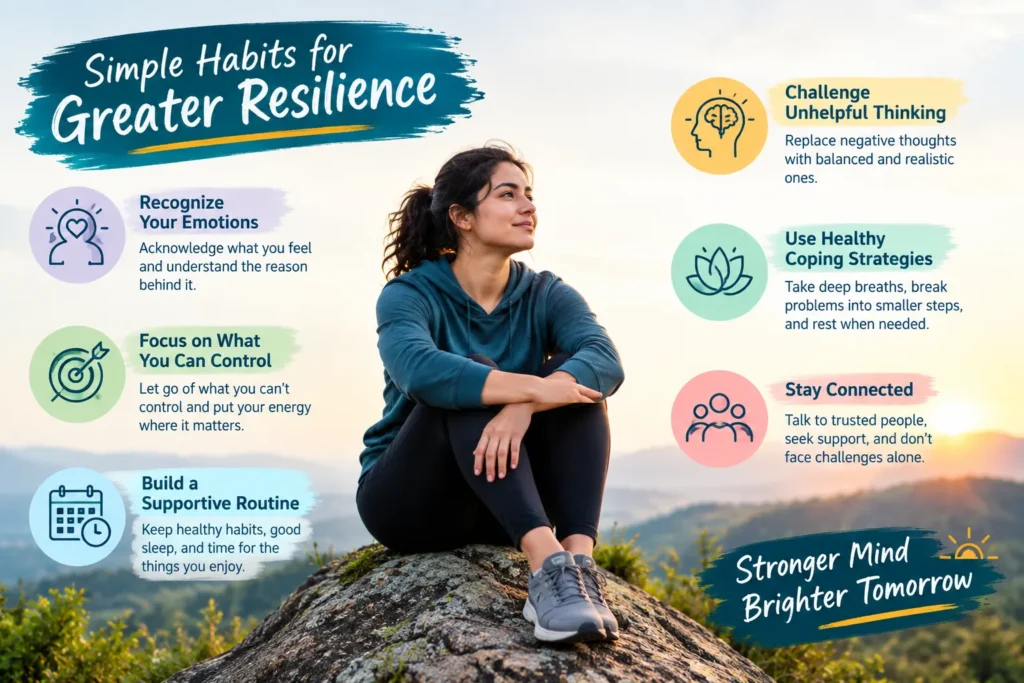
1. Recognize and Accept Your Emotions
Make a list of what you are feeling rather than jumping to conceal it. Instead of doing something like “I’m feeling anxious since I don’t know what will occur,” you may sound like an apathy mode and state, “Everything is dreadful.”
Recognizing an emotion doesn’t mean letting it go. It gives you the opportunity to discover the cause of the emotion and then decide if the response is logical.
2. Focus on What You Can Control
Stress is often more intense when you are focusing on areas that are not your responsibility. Sort your life into two groups:
- You are in control of your routines, actions, and communication, as well as boundaries and decisions.
- Beyond your control: other people’s decisions, unpredictable events, past errors.
This one-line distinction can cut down on mental stress and make issues appear more manageable.
3. Build a Supportive Routine
During difficult periods, basic routines can provide stability. Be sure to keep a regular schedule of food intake, sleep, and physical exercise, as well as study or work hours and the opportunity to unwind.
There’s no need to have a perfect plan. Simple routines give your mind stable points of stability in times of uncertainty.
4. Challenge Unhelpful Thinking
Your thoughts affect your stress response. If you find yourself thinking, “I can’t handle this,” inquire if this is true.
Think of something less extreme, such as ‘this is bad, but I can manage.’ By allowing yourself to move forward like this, you’re opening up the scope of possibility – one important step when building emotional resilience.
Practical Ways to Build Resilience When Stress Feels Overwhelming
Knowing the relationship between the effects of stress and resilience is important because stress can’t be completely eliminated from the daily routine. The objective is to learn more resilient responses to stress.
Try these strategies for resiliency:
- Stop before responding. Take a few deep breaths before reacting to an upsetting situation.
- Split issues into smaller pieces. Deal with one problem instead of attempting to resolve everything at once.
- Reduce the need for negative thoughts. Constant exposure to disturbing content or stressful conversations can create stress in the mind.
- Plan time to rest and recuperate. Rest is not an option when your mind and body are constantly under stress.
- Connect with your friends. Talking with a trusted family member, friend, mentor, or a qualified professional can give you a fresh perspective and emotional support.
How to Be More Resilient After a Setback
A setback could be an opportunity to learn about your preferences, habits, and boundaries more clearly. You can ask yourself three questions:
- What has happened?
- What do I gain from this experience?
- What is the most effective move I can make now?
It is not a matter of finding an opportunity to learn from every traumatic incident. There are situations that are truly challenging. The goal is to get an awareness of the situation instead of being stuck in the moment.
Building mental resilience strength is also accepting assistance when your current ways of coping aren’t sufficient.
Stress Resilience: Habits That Strengthen Your Response
Stress Resilience is enhanced whenever you regularly participate in healthy habits before the crisis takes place. Good habits consist of taking regular breaks, keeping social ties, having reasonable expectations, enjoying time outside, exercising frequently,y and allowing room for activities that you enjoy.
An effective plan is for you to create your own personal resilience plan. Make a list of 3 things that usually help you relax, 3 people who are usually available to talk to during a crisis, and 3 things that you can do to help yourself when things start getting too hectic.
Conclusion
Learning how to build emotional resilience starts with accepting your emotions, focusing on what you can control, and developing healthy coping habits. Resilience grows with practice, not by avoiding stress. Start with one small positive habit today and build your strength one step at a time.
Frequently Asked Questions
Is emotional resilience something that can be taught?
Yes. The capacity to be emotionally resistant can be acquired through experiences and practice. Seeking healthier ways of coping as well as enhancing emotional awareness and flexibility, will help you in dealing with the demands of the future more effectively.
How to become more emotionally resilient in a short amount of time?
There’s no quick fix; however, small, simple actions will aid in gaining a sense of stability. Take a break, take a breath, think of what you can do, call on someone you trust, and focus on a small task at a time.
What’s the difference between being resilient and ignoring your feelings?
Resilience is the ability to acknowledge emotions and make choices to be able to cope with them in a constructive manner. But with avoidance, one does not confront the emotions or accept them in one’s life – it is more of a dissociation because the emotions are removed from the real world or even fake.
What do social supports have to do with resilience?
The support of a supportive relationship can give you an opportunity for encouragement, perspective, as well as practical assistance, and an opportunity to vent difficult feelings. You don’t have to deal with every hardship by yourself.
What are some of the most basic ways to be resilient on days that are stressful?
Short breaks, regular schedule, adequate rest, and talking with a person with whom you feel comfortable are a few easy strategies. The following simple habits can also contribute to emotional resilience as time goes on.
How to get over failure?
Accept the failure, and then look at the lessons you have learned and what actions you could take the next time. Pay attention to the word failure, and take it in as a lesson, not a failure to make it.
Is resilience being positive about life all the time?
No, Resilience isn’t all sunny. Frustration, anger, sadness, even fear — such are the signs of a resilient response, and it gives you the power to choose and to move on.
What works for resilience as coping strategies?
These coping strategies are: awareness of emotion, problem-solving, effective routines, social support, relaxation, unrealistic self-talk and setting unreasonable boundaries. The most viable combination depends upon an individual.
When should I seek professional support?
Seek out the help of a professional when you feel that your emotional problems are overwhelming or affecting your day-to-day activities. Knowing how to build emotional resilience can also help you recognize when additional support may be useful.
